ADHD Time Hacks That Work (Even If Nothing Else Has)
If you’re searching for ADHD time hacks that work, I’m going to assume a few things:
You’ve tried planners.
You’ve tried alarms.
You’ve tried “just wake up earlier.”
And somehow you’re still late, overwhelmed, or stuck in a hyperfocus vortex reorganizing your spice rack at 4:52 PM.
This isn’t a discipline problem.
It’s a time perception problem.
ADHD brains don’t experience time the way neurotypical productivity systems assume we do. So if you want time management for ADHD adults that actually sticks, you need systems built for:
- Time blindness
- Task initiation resistance
- Dopamine-based motivation
- Transition lag
- Executive function fatigue
This post gives you the framework.
Not hacks for one good week.
Systems that work long-term.
Why Most ADHD Time Advice Fails
Most productivity advice assumes:
- You feel time passing
- You can internally pace yourself
- You can prioritize without friction
- You can switch tasks smoothly
According to CHADD, people with ADHD commonly struggle with time perception and delayed reward processing. That means “later” doesn’t feel real — and “now” dominates everything.
So when someone says “just plan better,” they’re ignoring the neurological gap.
You don’t need more discipline.
You need to externalize time.
The 5 ADHD Time Hacks That Actually Work
This framework works because it addresses time in order:
- Make time visible
- Reduce overwhelm
- Lower activation energy
- Automate decision triggers
- Sustain focus without rigidity
Let’s break it down.
(As an Amazon Associate, I may earn a small commission from qualifying purchases at no additional cost to you.)
1. Make Time Visible (Not Digital)
igital clocks are abstract. ADHD brains ignore abstract.
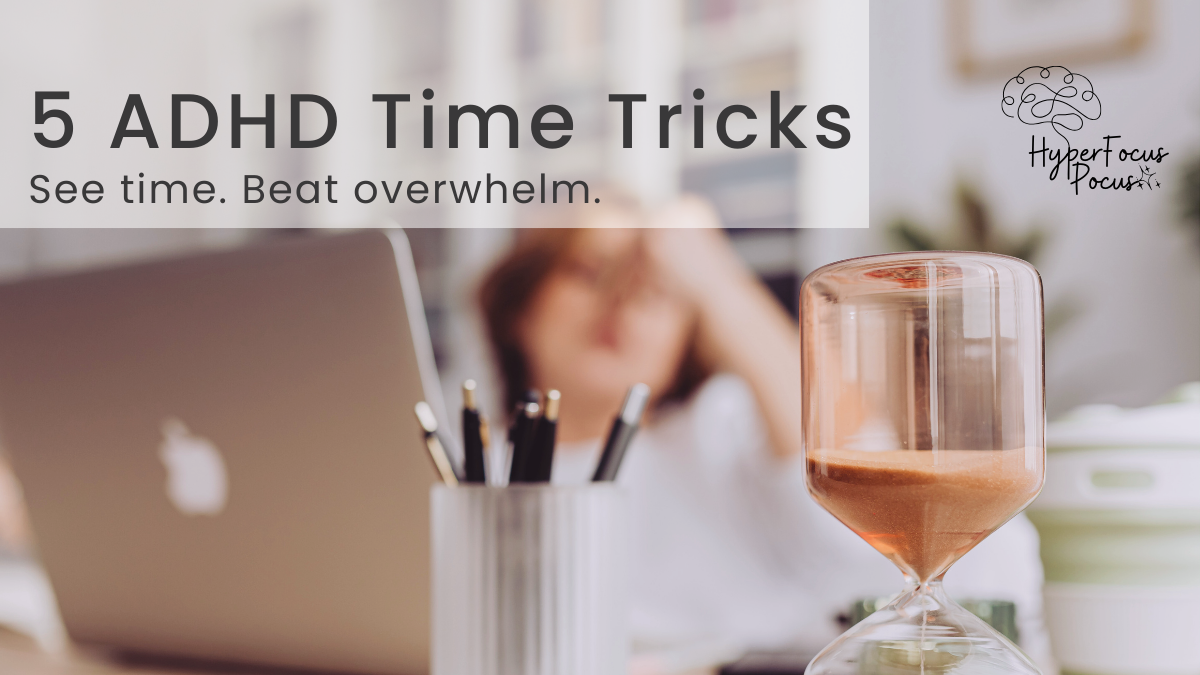
A visual timer turns time into something physical. You literally watch it disappear. Check out this desk timer on Amazon →
Instead of guessing how long 30 minutes feels like, you see it shrinking.
Why this works:
- Converts abstract time into spatial awareness
- Reduces time blindness
- Prevents hyperfocus time loss
- Decreases constant clock-checking
Place it directly in your line of sight. Visibility drives compliance.
2. Replace To-Do Lists With “Now / Not Now”
Traditional to-do lists overwhelm ADHD brains because everything feels urgent.
Instead, divide tasks into only two categories:
NOW (max 3 items)
NOT NOW (everything else)
No ranking. No color coding. No 17-step prioritization ritual.
Why this works:
- Eliminates prioritization paralysis
- Reduces cognitive overload
- Forces realistic capacity limits
Three tasks. That’s it.
If you finish them? Pull one from Not Now.
3. Use the Two-Minute Activation Rule
If something takes under two minutes, do it immediately.
Not because it’s efficient — because it reduces backlog.
Examples:
- Reply “Received”
- Throw away trash
- Book the appointment
- Send the file
ADHD resistance is strongest at the start.
Why this works:
- Lowers activation energy
- Builds momentum
- Reduces shame accumulation
Tiny completions compound fast.
4. Rename Alarms Into Commands
Alarms labeled “3:00 PM” are meaningless.
Instead, label them with the action:
- “Leave NOW”
- “Switch tasks”
- “Take meds + water”
- “Stop scrolling”
This turns reminders into executive prompts.
Why this works:
- Removes decision friction
- Reduces working memory strain
- Provides immediate clarity
If your brain has to think about what the alarm means, you’ve already lost momentum.
5. Structured Time Without Rigidity
Rigid hourly schedules collapse under ADHD unpredictability.
Instead, use flexible structure:
Morning → Admin + quick wins
Midday → Deep focus
Late afternoon → Lighter tasks
Evening → Reset
Add 10–15 minute buffers between blocks.
Then use adjustable Pomodoro cycles:
- 15/5 on low-energy days
- 45/15 during hyperfocus
- Visual Pomodoro timer required
Pair with body doubling through
Focusmate for accountability.
Why this works:
- Supports transition lag
- Accommodates hyperfocus
- Reduces “schedule failure” spirals
Structure helps. Rigidity backfires.
The Real Secret Behind ADHD Time Hacks That Work
All effective ADHD time systems share four traits:
✔ They externalize time
✔ They reduce decision friction
✔ They create visible cues
✔ They deliver quick dopamine
If a strategy doesn’t do at least two of those, it won’t stick.
That’s why planners alone fail.
That’s why “try harder” fails.
That’s why shame definitely fails.
Quick Start (If You Only Do One Thing)
Buy or set up a visual timer today.
Everything else builds on that.
When time becomes visible, behavior changes.
Final Thought
You are not bad at time.
Your brain simply doesn’t experience it the way productivity culture assumes.
The right ADHD time hacks don’t force you to become someone else.
They build systems around the brain you actually have.
And that’s when time finally starts working for you — instead of against you.
🔹 If you want real-life strategies that don’t fall apart by Tuesday, check out 6 Easy Productivity Hacks That Truly Work