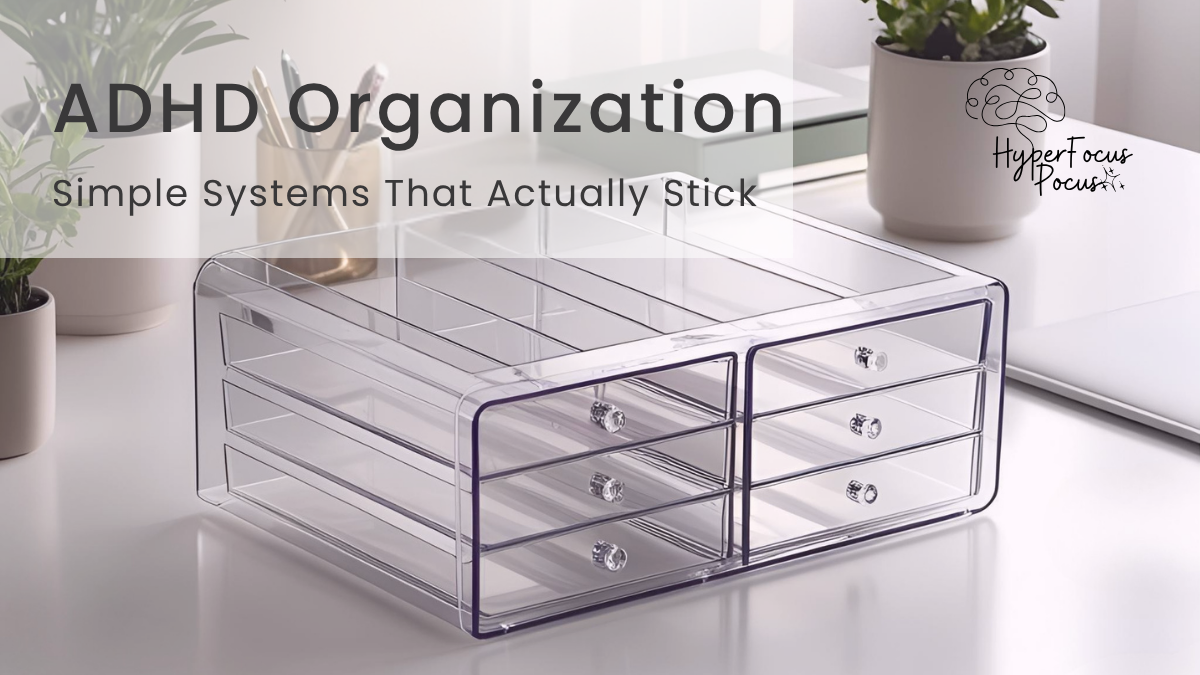
ADHD Organization Tips That Actually Work for a Brain That Loses Everything
If you have ADHD, being “organized” can feel like a system you’re constantly trying to rebuild… and somehow constantly losing.
You buy containers. You clean in bursts. You reorganize everything. Then a few days later, clutter is back, you can’t find your keys, and your brain is overwhelmed again.
That’s not a motivation problem. It’s a system design problem.
Most organization advice assumes:
- you remember to maintain systems
- you don’t forget items exist
- you enjoy putting things away
- hidden storage helps you focus
ADHD brains usually need the opposite:
- visible reminders
- fewer steps
- flexible systems
- fast resets
These ADHD organization tips are designed to reduce:
- clutter overwhelm
- lost items
- decision fatigue
- messy resets
- abandoned systems
No perfection required.
Why ADHD Organization Is So Hard (And Why Most Tips Fail)
ADHD organization is hard because you’re not just “putting things away.” You’re also:
- deciding where it belongs
- remembering the category
- resisting distractions nearby
- trusting you’ll find it again
- finishing the task
That’s a lot of executive function for something small.
This is why ADHD spaces often include:
- piles instead of categories
- items left out as reminders
- duplicates in multiple rooms
- “temporary” drop spots everywhere
- visible clutter that grows
Your brain is trying to avoid forgetting — not trying to create chaos.
The solution isn’t hiding everything.
It’s making the right things easier to see.
The Most Important ADHD Organization Rule: Organize for Retrieval
Traditional organization focuses on where things should go.
ADHD organization focuses on:
How fast can I find this?
How fast can I put it back?
Will I remember it exists?
If your system fails any of those, it won’t stick.
This means:
- open containers beat drawers
- broad categories beat detailed ones
- visible storage beats hidden bins
- fewer steps beat perfect systems
ADHD organization is not about perfection.
It’s about easy retrieval.
Stop Organizing by Category: An ADHD Organization Strategy That Actually Works
Most organization advice says:
Put like items together.
ADHD-friendly organization says:
Put items where you actually use them.
(This post may contain affiliate links. As an Amazon Associate, I may earn a small commission from qualifying purchases at no additional cost to you.)
Examples:
- scissors at desk, not supply drawer
- meds where you’ll see them
- chargers where devices die
- notebooks in multiple rooms
- mail bin where you drop keys
This removes friction.
If you must walk somewhere to put something away, the system often fails.
This is why a rolling utility cart works so well for ADHD organization. Bonus adulting points for an aesthetically pleasing solution like this woven basket-style cart on Amazon → It keeps items:
- visible
- accessible
- movable
- easy to reset
It turns clutter into categories without requiring perfect behavior.
Create ADHD-Friendly “Lazy Genius” Organization Homes
Your systems should work when you’re tired, distracted, or overwhelmed.
That means creating lazy genius homes:
- close to use
- visible
- flexible
- easy to reset
Examples:
Instead of:
“Office supplies drawer with dividers”
Use:
“Desk tools bin”
Instead of:
“Perfect paper filing system”
Use:
“Active papers holder”
Instead of:
“Detailed hobby storage”
Use:
“Hobby basket”
This is far more sustainable for ADHD brains.
This clear file sorter → works especially well here because it keeps papers:
- visible
- categorized
- easy to grab
- easy to reset
Without requiring filing energy.
Reduce ADHD Clutter Without Creating Fragile Organization Systems
Some systems look organized but collapse instantly.
Example:
Perfectly aligned desk setup
Color-coded micro categories
Minimalist hidden drawers
These require constant maintenance.
ADHD-friendly organization is resilient.
It still works when:
- you skip cleaning
- you’re overwhelmed
- things land randomly
- you forget
That’s why:
- big bins work better than small ones
- open containers beat lids
- broad categories beat specific ones
- trays beat drawers
If a system looks ruined when one item is out of place, it’s too fragile.
Use Visual ADHD Organization Cues (Without Creating More Clutter)
ADHD brains need visual reminders — but too many create noise.
So instead of leaving everything out:
- keep daily items visible
- contain backup items
- hide visual distractions
Think:
Important = visible
Noise = contained
This reduces overwhelm while preserving reminders.
Clear bins, open baskets, and desktop organizers help balance this.
This chic wooden valet tray → works well because it allows:
- quick toss
- visible reminders
- easy sorting later
- controlled clutter
Start With One ADHD Organization Reset Zone
Trying to organize everything at once usually backfires.
Start with one reset zone:
- desk
- entryway
- kitchen counter
- nightstand
- mail pile area
- “clothes chair”
Ask:
What keeps landing here?
What do I keep losing?
What would make this easier tomorrow?
Solutions:
- essentials tray
- paper sorter
- basket
- hook
- charging station
- drop zone bin
One small system can reduce daily chaos immediately.
Create ADHD “Permission Piles” to Control Clutter
ADHD piles often exist because decisions aren’t finished.
Instead of fighting this, create permission piles:
- active papers tray
- open loops bin
- returns basket
- project basket
- “deal with later” bin
This keeps reminders visible without spreading clutter everywhere.
A labeled basket for open loops works especially well if you tend to leave things out so you don’t forget them. Try this set of matching open-top labeled baskets on Amazon → to transform clutter into organized chaos.
Make ADHD Organization Dopamine-Friendly (So It Actually Sticks)
If a system is boring or annoying, ADHD brains ignore it.
So make systems satisfying:
- trays you like looking at
- baskets that feel intentional
- simple labels
- colorful notes
- visible organizers
You don’t need aesthetic perfection.
Just enough dopamine to make resets easier.
ADHD Organization Products That Make These Tips Easier
This post may contain affiliate links. As an Amazon Associate, I earn from qualifying purchases at no extra cost to you.
Here are more of my top picks for ADHD-friendly organization:
Stair basket — for minimizing those, “what did I walk up here for?” moments
Charging station — daily essentials landing spot
Open storage bins — category-lite organization
Stackable open-top baskets — controlled visible clutter
Clear rolling cart — visible categories + movable storage
You don’t need all of them. Even one can reduce overwhelm.
Why These ADHD Organization Tips Actually Work
These strategies reduce:
Search friction — easier to find things
Reset friction — easier to put things back
Shame friction — easier to recover after mess
Instead of relying on motivation or micro-decision making, they rely on environment design.
That’s why they stick.
Quick ADHD Organization Wins (Start Here)
Try one today:
Create one drop zone
Switch one drawer to open bin
Add essentials tray
Move items closer to use
Create permission pile basket
Use vertical organizer
Small changes work best for ADHD brains.
Related Posts
Read next:
ADHD Hyperfocus Management
ADHD Desk Hacks That Improve Focus
ADHD Work Routine That Actually Works
Or browse ADHD printables for simple systems that help reduce overwhelm.

One Comment